When “Noise” Becomes Silence: Why Grand Rapids’ Ordinance Threatens the First Amendment
JT
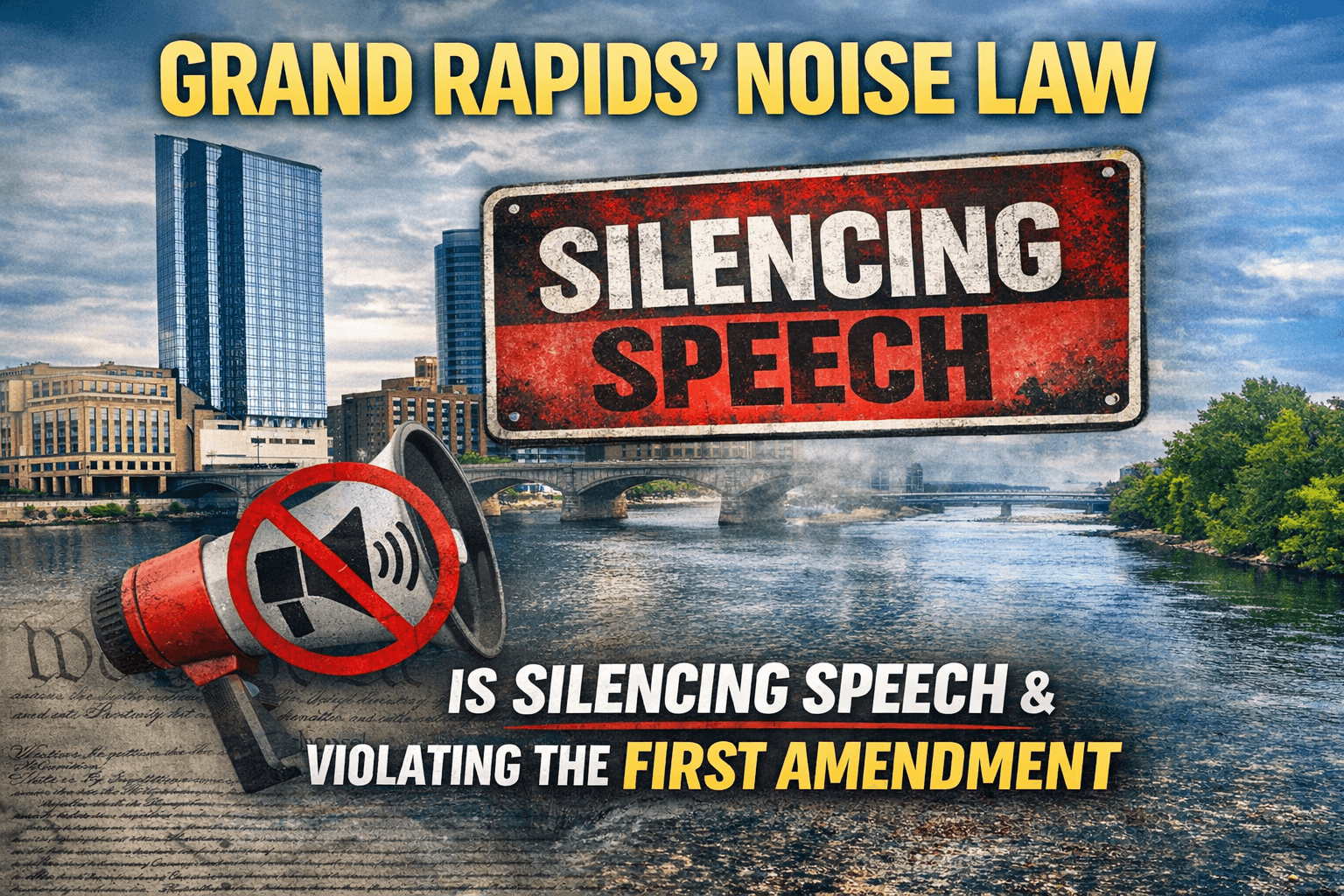
Local governments have a responsibility to maintain public order. No serious person disputes that.
But when a city begins regulating speech itself under the label of “noise,” it crosses a constitutional line.
That is exactly what is happening in Grand Rapids.
What has been presented as a routine noise-control update is, in practice, a mechanism that allows peaceful, ordinary speech on public sidewalks to be silenced not because it is dangerous or disruptive, but because it is audible.
And that should concern every resident of Michigan.
Public Sidewalks Are Constitutionally Protected Spaces
Public sidewalks are not optional free-speech zones. They are not privileges granted by city commissions. They are what the courts call traditional public forums, meaning they receive the highest level of First Amendment protection.
The U.S. Supreme Court settled this long ago in Schneider v. State, stating plainly that:
“The streets are natural and proper places for the dissemination of information and opinion.”
This principle does not disappear because speech is inconvenient, unpopular, or uncomfortable to hear.
Free Speech Includes the Right to Be Heard
Speech that cannot be heard is not communication it is performance.
In Saia v. New York, the Supreme Court made a critical clarification that many modern ordinances ignore:
“The right to be heard is placed on the same high plane as the right to speak.”
When a law punishes speech simply because it rises above “ambient sound” or reaches a listener who doesn’t want to hear it, the government is no longer regulating noise.
It is regulating speech itself.
What the Constitution Allows and What It Forbids
Cities are allowed to regulate excessive noise.
They are not allowed to suppress peaceful speech.
Under Ward v. Rock Against Racism, any regulation that affects speech in a public forum must:
Be content-neutral
Be narrowly tailored to a real government interest
Leave open ample alternative channels for communication
An ordinance that criminalizes ordinary conversational volume, relies on vague terms like “disturbing” or “annoying,” or forces speakers so far away that communication becomes impossible fails this test.
A rule that allows speech only when it cannot be heard is not a reasonable regulation. It is a contradiction.
Distance and Volume Rules That Kill Conversation Don’t Survive Review
The Supreme Court addressed this exact issue in McCullen v. Coakley, striking down laws that pushed speakers away from their audience under the guise of public order.
The Court emphasized that close, personal, conversational speech—including counseling, religious expression, and political advocacy—is at the heart of First Amendment protection.
If a regulation destroys that kind of communication, it is unconstitutional, regardless of intent.
Vague Laws Invite Selective Enforcement
Perhaps the most dangerous aspect of modern noise ordinances is how vague they are.
Terms like:
“disturbing”
“unreasonable”
“above ambient sound”
leave enforcement up to subjective judgment.
The Supreme Court warned against this in Grayned v. City of Rockford, explaining that vague laws invite arbitrary enforcement and chill lawful speech.
Here in Michigan, the Sixth Circuit reinforced this principle in Bible Believers v. Wayne County, making clear that listener discomfort or offense is not a lawful reason to silence speech.
The government’s duty is to protect speakers not silence them to keep the peace.
This Is Bigger Than Any One Message
This issue is not about abortion, religion, or politics.
It is about who decides when speech is allowed to exist.
Today, enforcement may target one group. Tomorrow, it could target another:
labor organizers
civil rights advocates
environmental protesters
political dissenters
The First Amendment was written precisely because governments cannot be trusted to decide which speech is acceptable.
A Call to the Grand Rapids City Commission
Commissioners are not merely administrators of comfort. They are stewards of constitutional rights.
Grand Rapids must:
Reevaluate how this ordinance is enforced
Adopt objective, disruption-based standards
Affirm that peaceful, audible speech on public sidewalks is protected
Ensure that “noise control” is not used as a tool for silence
History is clear: cities that suppress speech do not age well.
Why This Matters Now
Rights are rarely taken outright.
They are eroded through “reasonable” regulations that go unchallenged.
When speech becomes punishable simply for being heard, silence is no longer voluntary.
And once silence is enforced, it is no longer freedom.